7 THINGS TO KNOW ABOUT YOGA NIDRA

is50s

Yoga Nidra, also known as yogic relaxation therapy, is a practical health approach to treat or manage various psychosomatic disorders, such as peptic ulcers, colitis, bronchial asthma, menstrual irregularities, and cancer.

Yoga Nidra is a method of Pratyahara and a form of guided meditation that enables you to focus on your mind in a state of relaxed consciousness. In simple words, it is yogic sleep, allowing you to control your body’s relaxation response.

Unlike the standard meditation technique, Yoga Nidra focuses on deep sleep to calm your nervous system, relieving stress and anxiety symptoms.

A 2011 study concludes that women with menstrual irregularities can practice Yoga Nidra to reduce symptoms of major depressive disorders, such as stress, depression, anxiety, insomnia.

Here are seven things you need to know about Yoga Nidra.

1. Yoga Nidra is Simple

Yoga Nidra is one of the easiest yogic practices because you don’t need to perform turns, headstands, twists, and other physical postures. Unlike standard yoga practices that can last between 15 and 60 minutes, Yoga Nidra can span a few hours.

You can do this type of yoga at any time, except after consuming meals. The ideal time to perform Yoga Nidra is in the morning, after meditation or asana, or before you go to sleep. Although you don’t lose consciousness, your body and brain rest through deep relaxation.

2. Yoga Nidra Helps Treat Fibromyalgia

Fibromyalgia is a common health condition characterized by stress, sleep problems, and pain in different body areas. Yoga Nidra is an effective treatment option for fibromyalgia because it soothes your muscles and relieves chronic fatigue, insomnia, and pain.

A 2019 research study concludes that combining Yoga Nidra into your daily or weekly yoga program improves mood, decreases stress, increases self-confidence, soothes muscles, and reduces negative emotions associated with fibromyalgia.
s53on

3. Regulate Interoceptive Awareness

Practicing Yoga Nidra counteracts hyperactivity in your brain, especially in the frontal cortex, to regulate interoceptive awareness. It supports a restorative state of your brain and balances your body and mind.

When you practice Yoga Nidra, your brain transitions from an active state of beta waves into alpha waves, relaxing your subconscious mind and releasing chemicals like serotonin to soothe your brain.

Serotonin releasing in the alpha phase moves your body into a deeply relaxed state, leading to tranquility. When you enter into a deeper conscious sleep, the brain emits delta waves, causing restful sleep and improving your overall health and wellbeing.

One study highlights that Yoga Nidra meditation increases dopamine levels in the ventral striatum and helps calm people with social anxiety. Researchers provide evidence that Yoga Nidra triggers the brain’s pineal gland to release melatonin, a hormone that promotes sleep.

4. Yoga Nidra Starts with Savasana

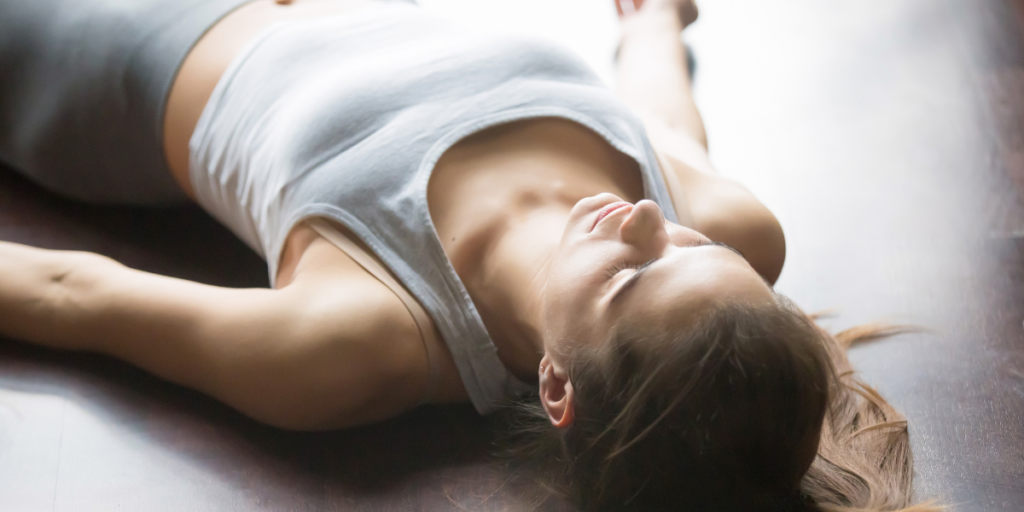
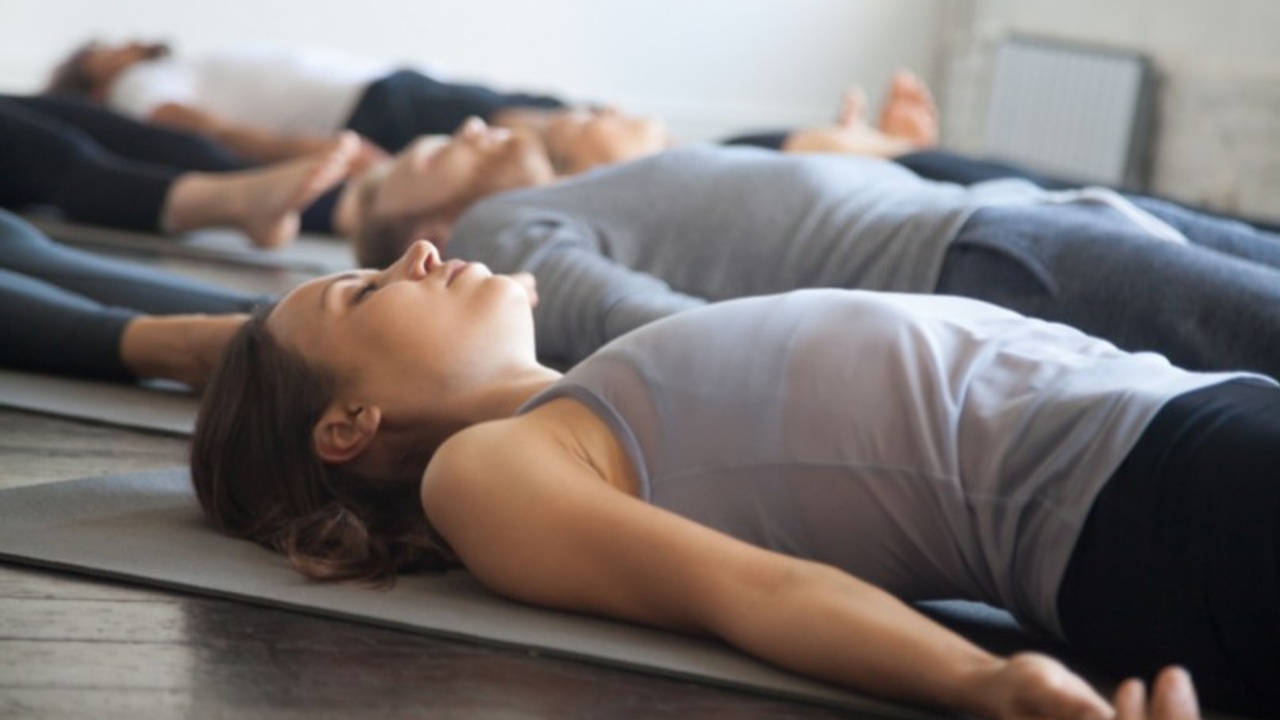
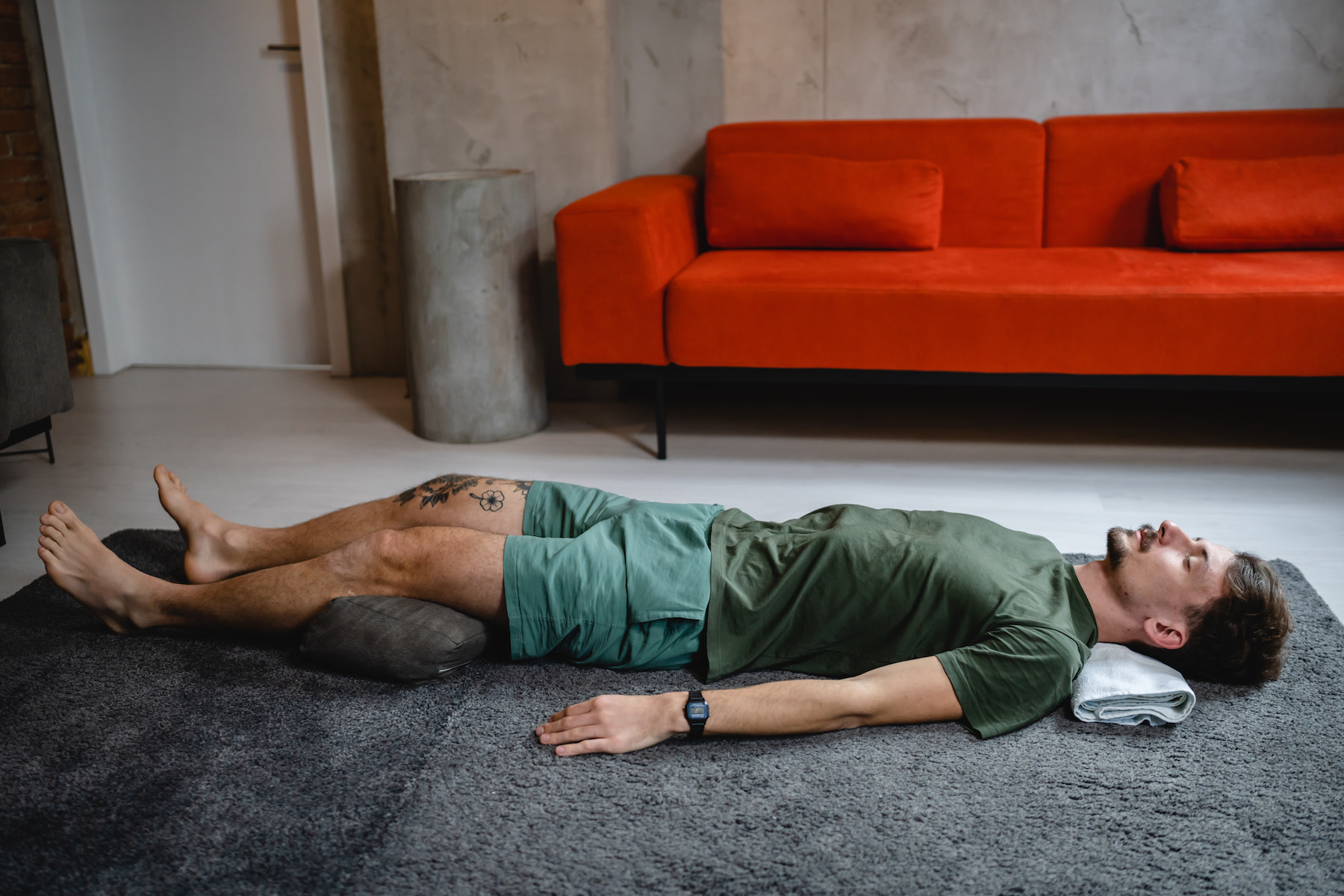
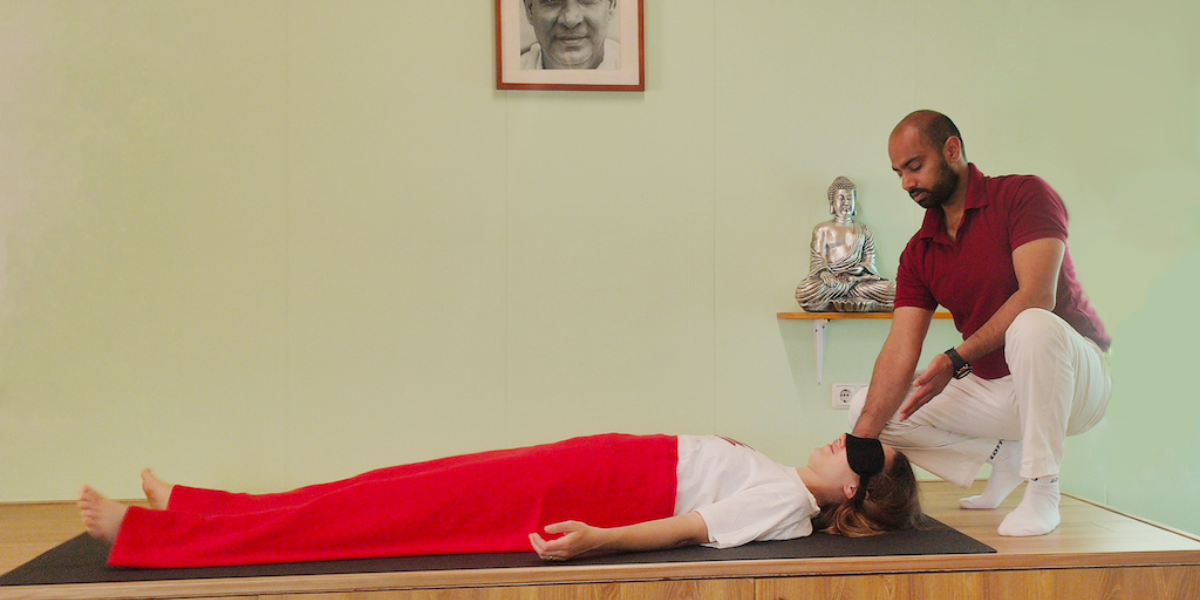
You start Yoga Nidra by placing your body in Savasana. A qualified guru teaches his students to move and rotate their consciousness or awareness through different body parts, relaxing each part while staying still.

Putting your body in Savasana helps integrate your muscle memory and nervous system. It enables your blood pressure and heart rate to return to their baselines. When your body achieves the baseline thresholds, it slowly transitions to a relaxed state, allowing you to reflect on your feelings.

Starting Yoga Nidra in Savasana recalibrates your body and mind to reboot your day, primarily if you practice it in the mid-afternoon. Experiencing Yoga Nidra in the Savasana posture helps you remain conscious and alert.

5. Yoga Nidra Originates From Tantra

Tantra focuses on your body’s subtle energies to enhance your physical health and spiritual wellbeing. It helps you explore your body energies and their connection to the spiritual dimensions, allowing you to align your breath, emotions, feelings, and Prana (subtle energy).

When you enter into a relaxed state of Yoga Nidra, your body works with Pranamaya kosha to purify your chakras and activate kundalini energy, awakening your divine purpose and cleansing your energy systems, such as meridians and chakras. A 2008 study shows that Yoga Nidra is a sophisticated meditation tool to streamline your kundalini energy.
gfluj

6. Improves Sex Life

A growing body of research evidence highlights that some types of sexual dysfunctions can be managed by treating mental health conditions. Yoga Nidra increases your brain and body awareness, increasing blood flow to different body organs, including your genital area. It helps eliminate toxins and improves overall sexual performance.

A recent study performed by Anjali Mangesh Joshi and fellow researchers found that Yoga Nidra is a deep relaxation technique to reduce stress and depression. The study concludes that combining Yoga Nidra with meditation, tantra yoga, kundalini yoga, and Bindu Samrakshana can regulate hormones, strengthen pelvic muscles, and manage risks associated with sexual dysfunction.

7. Yoga Nidra has Eight Stages

The eight stages of Yoga Nidra are internalization, Sankalpa, consciousness rotation, breathing awareness, the manifestation of opposites, creative visualization, repeated Sankalpa, and externalization. During the internalization stage, your awareness transitions inwards from the physical body.

When you enter Sankalpa, you set a specific intention to achieve a higher level of consciousness. Your body guides you to rotate your consciousness and visualize your body part by repeating its name. You focus on your breathing and explore opposite emotions to create simple visualizations based on various topics in your mind.

Repeated Sankalpa is the next stage in which you repeat the original intention and make it penetrate deep inside your body and mind. Bringing sensations back to your body is the final stage of Yoga Nidra, known as externalization.
6orvq[……]

Read more

Yin Yoga & The Rebound Effect

gogp3

This may be the most important part of a Yin Yoga practice.

It’s called the rebound, and it’s a short period of rest after a single Yin posture. In its simplest form, you just lie down on your back to feel the after-effects of a pose.

The experiences people have in the rebound can range from relaxation to euphoria. So what is it, and why is it so powerful? The best way to understand it is to experience it in your own body. Here’s a guided yin session which has long holds of 4-5 minutes and long rebounds of 1 minute or more.

To understand what’s happening in the rebound, we can start with its more familiar variation: savasana.

How the rebound is like Savasana

The rebound resembles a short savasana, which is a period of rest and stillness customarily done at the end of a yoga practice. Savasana (pronounced sha-VA-sa-na) typically lasts for 1-10 minutes and is intended to integrate all the energetic and physical sensations one might feel after a sequence of yoga postures.

Savasana is a Sanskrit word that literally means “corpse posture,” and in yoga it usually indicates lying down and remaining still – like an expressionless, non-living body.

But in modern yoga, savasana has taken on a dual meaning: in addition to the physical posture it describes, yogis also associate it with a particular state of deep relaxation – a state that only happens at the end of a yoga sequence.

There’s something special about this time. For many people, after awakening the subtle energies of the body during the posture sequence, they can access an exquisitely deep state of calm in savasana. There can often be vivid inner sensations like floating in space or dissolving into one’s surroundings. A yogi might also feel strong sensations of movement, even though the body is completely still.

Savasana can be a special and intimate time to engage with one’s own inner energy. This might be why many yogis say that Savasana is their favorite part of a yoga practice

How the rebound feels

In Yin Yoga, instead of the familiar savasana that’s done all at once after a full sequence of postures, the yogi takes a shorter savasana after each posture. Many yin yoga teachers call the rebound. A typical timing is to hold each yin posture for 2-5 minutes, followed by a 1-minute rebound, but there can also be variations on the timing.

After releasing a pose, the sensations a yin yogi feels can be stronger than what she felt while holding the pose. These sensations might arise in different parts of the body and are described as tingling, warmth, fullness, expanding, contracting, or a number of other inner experiences.

The rebound is often done while lying on the back in savasana, but it can also be done in other passive positions such as child’s pose, resting on the belly, or resting with legs up the wall.

The rebound is one of the most accessible forms of meditation available. The sensations of the rebound arise naturally and can completely absorb the practitioner’s attention and awareness, resulting in a fulfilling time to recharge.

Many Yin Yoga teachers do not include rebounds as part of their sequences and instead move from one pose right into the next. In my 20+ years of teaching Yoga I’ve come to see them as indispensable, and when I guide my online Yin Yoga Teacher Training I recommend that trainees integrate them into every sequence.

The science of the rebound effect

What’s really happening inside during the rebound? Yogi scientists Paul Grilley and Bernie Clark discuss this as a change in the “phase” of the body’s fascial fluid – the water that runs through and around the fascia. The change is from a “gel” phase (more viscous) to a “sol” phase (more liquid). Yin practice and other forms of myofascial release are believed to encourage this change.

The result is that the tissues becomes looser and release tension, which for many people feels like a state of relaxation and calm. In my studies with Paul Grilley he has said that Chi is the link between the physical and the astral bodies. It has a dual nature. That’s why the rebound after a pose can be felt physically and is also emotionally and mentally calming.

But for some people, this gel-sol change can create sensations beyond relaxation, such as floating. This makes sense in terms of the gel-sol change since fascia is suspended in a more fluid environment than usual. The feeling can even be hallucinogenic as the body transforms into a less grounded and more dynamic state.

The gel-sol phase change is a temporary state that’s healthy and beneficial to the body. Similar to rinsing a sponge out, when we do yoga we squeeze and compress the body’s tissues to discharge stagnant fluid and soak up fresh fluid.

According to the Modern Meridian Theory proposed by Dr. Hiroshi Motoyama, the meridians of acupuncture flow through the fascial fluid, and the rinsing process renews the body’s Chi.

A more Western view on what’s happening is called the Relaxation Response – a phenomenon studied by Dr. Herbert Benson, who describes it as an activation of the parasympathetic nervous system. The Relaxation Response is the opposite of anxiety and stress. In deep states of relaxation, your body and brain heal and repair themselves from stressful periods, releasing chemicals and brain signals that make your muscles and organs slow down while increasing blood flow to the brain.

A mystery that continues to unfold

In all the years I’ve been guiding yin yoga journeys, I’ve learned that what yogis see, feel and experience during the rebound can be wildly different from one person to the next. This makes me think there may be a more complex network of energetic forces not yet understood by science that’s responsible for this variety of euphoric feelings.

I don’t claim to understand it, but I like to imagine that these sensations are some kind of manifestation of our individual life force – our essence energy – expressing itself.

[……]

Read more

The Perfect Vinyasa Flow Routine For Beginners

When you’re just starting to learn about yoga, it can be very confusing to understand all the different practices and paths. It takes study and self-reflection to find the path, or Marga, that calls to the individual.

If you want to get into the habit of yoga, sign-up to our free 30-day yoga challenge by clicking here. You will discover its deeper and more personal meaning as you progress in your routine.

One contemporary path often chosen is a subcategory of Hatha yoga called Vinyasa yoga.

A flow in Vinyasa is like a dance, linking each physical movement with the breath and finding flow in every pose and transition. For a lot of yoga beginners, tight hips and shoulders are often the main complaint or target areas. The flow below is perfect for beginners because it’s a heart opener that also focuses on the hips and shoulders.

Vinyasa Flow for Beginners

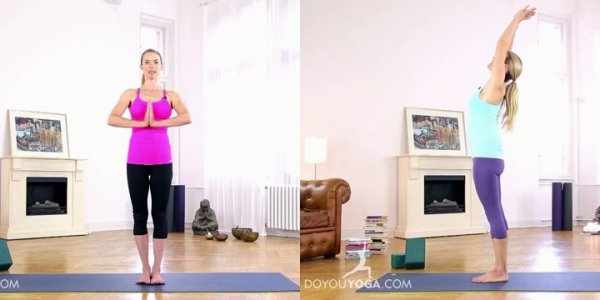
1. Mountain Pose → Urdhva Hastasana/Upward Salute

ku5l4

Transition: Slowly inhale the arms up with the palms facing up to scoop all the energy around the body, allow the palms to gently meet above the head, then exhale the hands down to heart center, repeat 5 times (slowing down each round if possible).

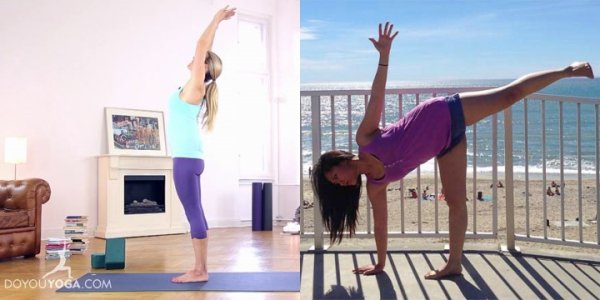
2. Urdhva Hastasana/Upward Salute → Half-Moon

o11h5

Transition: Slowly sway side to side to open up the body, hold each side for a few breaths. When back to center, exhale the arms down to heart center and go into forward fold.

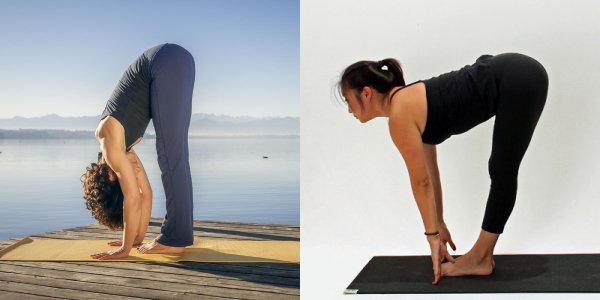
3. Forward Fold → Ardha Uttanasana/Standing Half Forward Bend

y178u

Transition: Inhale the hands to the shins, thighs, or hips, and lengthen the spine all the way from the tailbone to between the ears. Soften the face, exhale and release the legs and back, back in forward fold.

Release the hands to the mat, bending the knees (if needed) and step back with the right foot and lower the knee, place weight on the left foot and right shin.

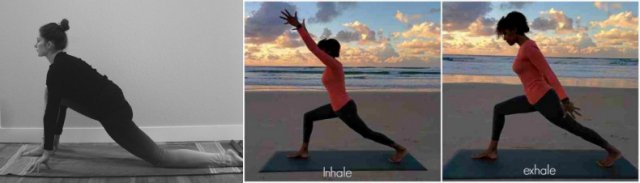
4. Anjaneyasana/Low Lunge → Utthita Ashwa Sanchalanasana variation/Flying High Lunge

n3lle

Transition: In low lunge, inhale the arms up and exhale sweep them back into flying arms (sternum leading with the palms face down about mat distance apart by the hips) while lifting the back leg for high lunge. Inhale and lift the arms back up and lower the back leg down to low lunge.

Repeat 3 times ending with an inhale-arms up to the sky in a low lunge, and release the arms to the floor and step back into Plank (left foot will meet the right at the back of the mat).

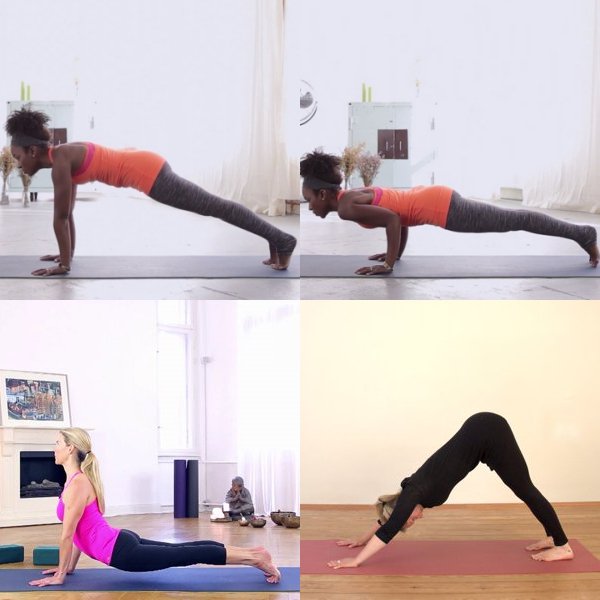
5. Plank → Chaturanga Dandasana → Upward-Facing Dog → Downward-Facing Dog

ne7gt

Transition: Most closely associated with Vinyasa Flow, these four asanas make the foundation of the flow. Take time inhaling in Plank, exhaling to Chaturanga, inhaling for Up Dog, and exhaling for Down Dog.

The flow comes from slowing down the movements and finding the juiciness of the body when it can inhale a little more and exhale a little more.

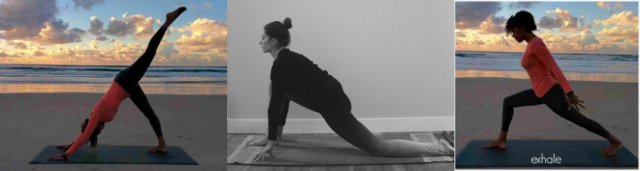
6. Three-Legged Down Dog → Anjaneyasana/Low Lunge → Utthita Ashwa Sanchalanasana variation/Flying High Lunge

zmncy

Transition: Inhale the right leg high and exhale to lightly sweep the right leg in-between the arms for low lunge. Repeat step 3 except at the end when the arms release to the floor, slowly step up to standing forward fold (left foot will meet right at the top of the mat).

7. Uttanasana/Forward Fold → Ardha Uttanasana/Standing Half Forward Bend

y178u

Transition: Slowly bend the knees and lift the arms for upward salute to Mountain pose.

8. Tadasana/Mountain → Urdhva Hastasana/Upward Salute

ku5l4

Transition: After exhaling hand to heart center, continue folding forward.

9. Uttanasana/Forward Fold → Ardha Uttanasana/Standing Half Forward Bend

y178u

Transition: Step back with the left foot and lower the knee, place weight on the right foot and left shin.

10. Anjaneyasana/Low Lunge → Parivrtta Sanchalasana/Low Lunge Twist Pose

z8687

Transition: In low lunge, inhale the arms up and exhale, release them to heart center. Then twist with the spine so the left arm meets the right leg, keeping the chest lifted off the leg, allowing the palms to gently press into each other.

Hold for 2-3 breaths then shift the arms back to center and release them to the ground, slowly step back to Plank (right foot will meet the left at the back of the mat).

11. Plank → Chaturanga Dandasana → Upward-Facing Dog → Downward-Facing Dog

ne7gt

12. Three-Legged Down Dog → Anjaneyasana/Low Lunge → Parivrtta Sanchalasana/Low Lunge Twist Pose

uvwib

Transition: Inhale the left leg high and exhale to lightly sweep the left leg in-between the arms for low lunge. Repeat step 9 except at the end when the arms release to the floor, slowly step up to standing forward fold (right foot will meet left at the top of the mat).

13. Uttanasana/Forward Fold → Ardha Uttanasana/Standing Half Forward Bend

y178u

Transition: Slowly bend the knees and lift the arms for upward salute to Mountain pose.

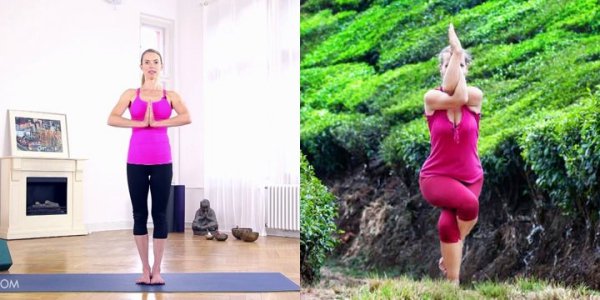
14. Tadasana/Mountain → Garudasana/Eagle Pose

hehxn

Transition: In Eagle pose, try to keep the hips square like headlights. When the right leg is over the left thigh, the right arm is under the left arm and vice versa on the other side. Hold 5 breaths on each side.

15. Urdhva Hastasana/Upward Salute → Mountain Pose with Prayer Hands

wxxvc

Transition: After exhaling hand to heart center, bow the head to seal the practice. Feel free to end here or continue creating a flow of choice.

[……]

Read more

Viniyoga: breathing and movement

uaa63

Viniyoga is a unique approach to yoga that adapts several aspects of the practice to each individual and stimulates the link between breath and movement.

“Viniyoga is hatha yoga, that is, the yoga of postures and breathing. And Viniyoga means ‘Yoga adapts to the person, not the person to Yoga’. It is a therapeutic style, as the sequences and postures are not ‘one size fits all’, but personalised”, explains Rachel Rose, instructor of Mind & Body disciplines at SHA Wellness Clinic.

If yoga is perfect for any health programme, here we are talking about a system with a very clear teaching method in which postures and breathing are developed progressively. It is the embodiment of the teachings of the yogi Tirumalai Krishnamacharya, considered the father of modern Yoga.

Gentle and slow, deep and meditative

“The careful attention to the link between breath and movement is what makes Viniyoga unique. It is gentle and slow, yet deep and meditative. It benefits both young and old, precisely because of its ability to adapt to the abilities and needs of the student”, stresses Rachel Rose.

Personalised treatment is the basis of an optimal health plan. And with Viniyoga, which is synonymous with health, something similar happens: in the individualised sessions, the teacher assesses the student and designs a plan specifically adapted to that individual so that maximum possible benefits are gained.

The asanas (postures) are the same as those found in any other style of Yoga, but with one important caveat: they are performed differently.

Thus, the postures are not entered directly, but progressively. It is important to warm up the muscles with repetitive movements and then enter and hold the posture. The sequences are also different depending on the assessment and the objectives to be worked on during the session.

As mentioned, another of the most interesting and distinctive features of Viniyoga is the breathing. The breathing changes with each movement during the sessions, coordinating inhalation and exhalation in harmony with the moves. There are several repetitions of the same movement, coordinating breathing and warming up muscles, before entering the posture and holding it.

A type of yoga that is pure SHA

The benefits of Viniyoga are extraordinary. “It is a discipline that significantly enhances mental and emotional stability. It leaves the student feeling very calm, alert and relaxed”, says Rachel Rose.

Every Viniyoga session involves a meditation in movement and its approach to asana is never painful. Viniyoga is also flexible in terms of personal practice.

“We find it best to do short, but consistent sessions. That makes a difference with other types that often insist on 90-minute sessions, a length of time that is difficult for many people to sustain”, says the SHA Wellness Clinic expert.

Another of the major benefits of Viniyoga is that it makes no distinctions: it is suitable for everyone because it adapts to the needs and abilities of the student.

“The way it fits into the student’s life—the postures themselves, the length of time and time of day, the inclusion of pranayama and meditation—makes Viniyoga a part of everyday life. Without needing to ‘be a yogi’, we can practice yoga and reap its benefits”, says Rachel Rose.

Viniyoga fits SHA’s raison d’être like a glove. In the Mind & Body department, we find that the vast majority of our guests know how to take care of themselves and already have fitness programmes in place, but at the same time they often suffer from stress, insomnia and anxiety, as well as jet lag due to frequent travel.

This variant of yoga helps these guests feel more relaxed, engage in meditation and settle into conscious breathing. It is an excellent ‘first contact’ with Yoga and meditation.

“It allows us to create short sequences for guests who want to continue the practice at home. As many guests repeat a few times a year, we can follow up from one visit to the next to encourages further practice”, concludes Rachel Rose.

[……]

Read more

22 Day 200Hr Traditional Kundalini Tantra Yoga TTC in Goa

fwnv6

Discover the inner yoga of ancient India, the yoga of awareness and presence, and the secret of absolute freedom! Mukta Tantra Yoga is the traditional Tantra yoga of Kundalini, Tantric asanas and chakras, mantras, meditations, philosophy, Tantric breath, sounds, vibrations, and elements.

Our location in Agonda, South Goa is just 200m walk from the beach, surrounded by nature, coconut trees and lulled by the sound of waves. Onsite, you will find private rooms with attached bathrooms, and our open roof top yogashala with amazing nature and sea view.

Note that there are no sexual activities in our courses as it is based on Indian Traditional Tantra Yoga and not on new-age Western Tantra.

Mukta Tantra Yoga is not Hatha Yoga or Neo Western Tantra or Western Kundalini Yoga. Historically, it is the only philosophy in the world that is not male chauvinistic and doesn’t discriminate between any nationality, class, color, gender, sexuality and religion.

It has evolved very differently in a non-dualistic environment and passed orally from generation to generation in a practical way.

Mukta Tantra Yoga is a golden secret key to absolute freedom. It is the Essence of all Asiatic Mysticism. It is inspired by Traditional Kundalini Tantra Yoga and Kashmir Shaivism (also called Himalayan Tantra, Agama, Trika, etc.) and by Mukta’s Father and various Mystics as well as Mukta’s life experiences.

Therefore this type of yoga cannot be found through self-claimed scholars or their books and it is not a commodity that you can buy. It is a heart-to-heart connection and a direct perspective of a free mind.

Following Tantra is not a goal, rather understanding oneself is being Tantric. Tantra is a signboard to rightly understand oneself. In this way, the awakening of true intelligence can manifest itself.

‘Mukta‘ means ‘free’ or liberated. ‘Tantra‘ is a science to crack the code of our true nature (pure consciousness, bliss, or freedom) which is eternal and always free from body, mind, and feelings. There is no goal to achieve but rather experiencing the true bliss of life which is already there.

Latest News: All travelers, vaccinated and non-vaccinated, are now allowed to enter India, under the provision of Tourist visas and e-Tourist visas (or another visa).

[……]

Read more

Sivananda Yoga & the Divine Grace Ashram

8nmdo

Yoga offered by the Divine Grace Ashram

We are grateful and honored to share the blessings of Swami Sankarananda and the Divine Grace Ashram – now an integral part of ChocolaTree’s grander vision. Together, we now offer weekly co-sponsored events including, Sivananda Yoga classes around the valley, yearly larger “Holyday” celebrations, and seasonal gatherings like our Christmas sold out feast, or our ongoing Soup for the Soul Wednesdays in the lounge, at ChocolaTree.

What we practice is Sivananda Yoga, a classical and holistic healing system, which stretches and tones the entire body. Sivananda Yoga helps both body and mind gain and maintain a natural healthy state. The practice emphasizes proper exercise, relaxation and breathing – each ninety-minute Asana practice begins with breath work and closes with a full body and mind relaxation.

Yoga, simply put, means union. Union of the individual with the supreme, or union of one’s body, mind, and spirit so that our actions, our words, and our thoughts are in alignment. Yoga is not a religion but a spiritual practice that can be incorporated into one’s daily life no matter what religion you follow, whether it is Christianity, Buddhism, Islam, Hinduism, or Atheist.

fuk3a

The teachings of Yoga go far beyond simply physical exercise or stretches. Even the Asana part of Yoga, which is not purely physical, has mental and spiritual benefits.

By closely observing the lifestyles and needs of people in our modern world, Swami Vishnudevananda synthesized the ancient wisdom of Yoga into 5 basic principles, which can easily be incorporated into your own pattern of living, to provide a long, healthy and happy life.

uw3ew

The five points of Yoga are:

Proper Exercise – Asanas

Proper Breathing – pranayama

Proper Relaxation – Savasana

Proper Diet – Vegetarian

Positive Thinking and Meditation – Vedanta and Dhyana

The Body is a vehicle for the soul, and has specific requirements, which must be fulfilled for it to function smoothly and supply the optimum mileage.

Proper Exercises act as a lubrication mechanism for the joints, muscles, ligaments, tendons and other parts of the body by increasing circulation and flexibility. Yogic exercises are in fact called asanas, or steady pose; when done correctly, influence and positively energize all the systems of the body. In terms of muscles, yogic exercises not only strengthen the muscles but also stretch them. There is a great emphasis on the flexibility and the youth of the spine. The correct postures are performed with awareness and concentration, accompanied by breathing and relaxation. Thus yogic exercises affect not only the physical body but also the astral body, the energetic body and the mind. The body and mind are put in alignment or in harmony. Yogic asanas prepare the body and mind to be strong for further practice of concentration and meditation.

3pikj

Proper Breathing: Yoga emphasizes breathing using the diaphragm. Increase the intake of oxygen though deep inhalation and release the toxins appropriately through our deep exhalation. Breathing techniques (pranayama) are devised to further purify the nadis, balance the breath and the energy in our system, and to store and channel the subtle energy (prana) for higher purposes. Balance the regulation of the harmonized breath helps the Yogi to regulate and steady the mind.

Proper Relaxation techniques such as Savasana cool down the system. Our hectic modern and fast lifestyle brings about physical, mental and spiritual stress. Stress comes from our difficulty to adapt to new challenges, and our lack of vital energy (prana) to cope with demands. Physical relaxation removes tension and allow the flow of prana, mental relaxation keeps the mind focused on neutral and uplifting objects like the sound of the breath or the mantra OM and from withdrawing the mind from sensual stimulations. Spiritual relaxation comes when we connect with our Inner Self and become a detached witness to the body and mind. Retiring the body. Mental and emotional stress comes from a hectic lifestyle, highly demanding jobs, distractions of the mind, low vitality due to lack of prana, and negative emotions such as anger, hatred, jealously, fear and anxiety. Physical relaxation, mental relaxation, spiritual relaxation is a deeper type of relaxation, when we become contact, a detached witness of the body and mind.

[……]

Read more

These 9 Restorative Yoga Poses Will Give You the Relief You’re Craving

vv6my

If you prefer fast-paced dynamic workouts such as HIIT, rowing, and power yoga, you may see exercise as an opportunity to break a sweat and bring your heart rate up. And while there’s nothing wrong with those motivations, sometimes your body needs something a bit calmer and gentler to quite literally ground you back down to earth. You may want to consider restorative yoga, a perfect option for balancing out your workout routine while also helping alleviate stress. Read on for some of the best restorative yoga poses to try.

What Is Restorative Yoga?

When you think of yoga, you might imagine pushing back into Downward-Facing Dog (Adho Mukha Svanasana), flowing through Sun Salutations (Surya Namaskars), or going upside down into a Handstand (Adho Mukha Vrksasana). Unlike these more active postures and sequences, restorative yoga allows you to simply let go and melt into your mat.

“Restorative yoga differs from other types of yoga in that it is completely passive and supported,” says Peloton instructor Anna Greenberg. “There’s no effort from the practitioner at all to hold themselves up in any of the postures.”

Restorative Yoga vs. Yin Yoga: Key Differences

Be careful not to conflate restorative yoga with Yin Yoga. While both of these practices involve slowing down and maintaining longer holds than you’d find in other yoga classes, they’re far from interchangeable. Yin Yoga requires more effort and action—and can feel intense. “In Yin Yoga, you hold deep stretches that work on stretching the connective tissue for long periods of time, which can be very sensational,” Anna says.

Restorative yoga, on the other hand, facilitates a sense of surrender and release. “In restorative yoga, we’re not looking for intensity or deep stretches,” she says. “We’re looking for total support so that our nervous system can relax and we can tap into our parasympathetic nervous system (the rest-and-digest state).”

Restorative yoga can be the perfect antidote to stress. A 2023 study published in the Journal of Education and Health Promotion found that participants who completed a 45-minute restorative yoga session once a week over a six-week period demonstrated improvements on 13 out of 14 markers of well-being. Of these markers, participants had the most notable increases in feeling more relaxed and thinking more clearly. It’s not a surprise when you consider the roots of restorative yoga.

“One of the biggest benefits of restorative yoga is that it takes us back to that internal rest-and-digest state where we truly restore ourselves from the inside out,” Anna says. “We’re able to process experiences, to truly relax, and to fill up our own cup.”

[……]

Read more

Book Bolt Software