Take a swing at aerial yoga at home
Over the past decade, aerial yoga classes with names like “anti-gravity,” “flying” and “acrobat” yoga have appeared on studio schedules – and with names like those, there’s an intimidation factor.
But many people don’t realize that if you’re capable of sitting on a playground swing or lying on a hammock, you’re actually capable of doing aerial yoga.
Despite its sexy appearance, aerial yoga isn’t just about the spectacle of hanging from a silk swing. Like traditional yoga, it actually has many stress- and pain-relieving benefits. In fact, being able to invert with the swing’s support can decrease spinal compression in the same manner as inversion tables used by physical therapists and chiropractors. Personally, I find that supported inversions in a yoga swing ease pressure and release my low back in a satisfying way no other technique ever has. Because of this, I was inspired to hang one in my garage gym and recommend it to anyone who gets relief from low-back decompression or simply wants to add a fun tool to their health and wellness arsenal at home.
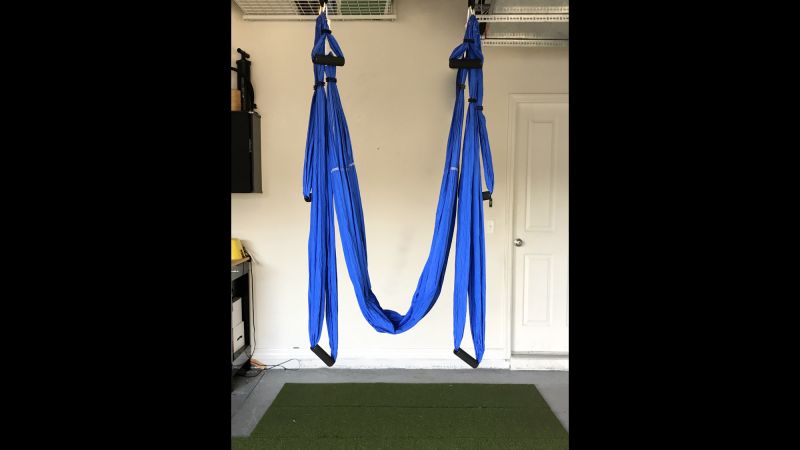
Courtesy D. SantasYou can find numerous yoga swings online with prices ranging from $50 to $150. Although swings are generally made of silk or silk-like fabric in a consistent hammock size (I refer to the U-shaped section of the swing as the “hammock”), there are variety of handle styles available. Some swings feature only drapes of fabric as holds on either side, while others have single, double or triple sets of handles. My swing has three sets of handles of varying lengths, which I think offers added support and comfort for navigating different positions.
When hanging your swing, follow all of the directions to ensure that you have it at the right height with enough space for safe freedom of movement. It’s essential that you use a solid support that can sustain your swing’s maximum weight capacity, usually about 300 pounds. If you install permanent anchors in the ceiling, you must use studs; if you’re unsure of how to establish the proper mounts, get a contractor to help you.
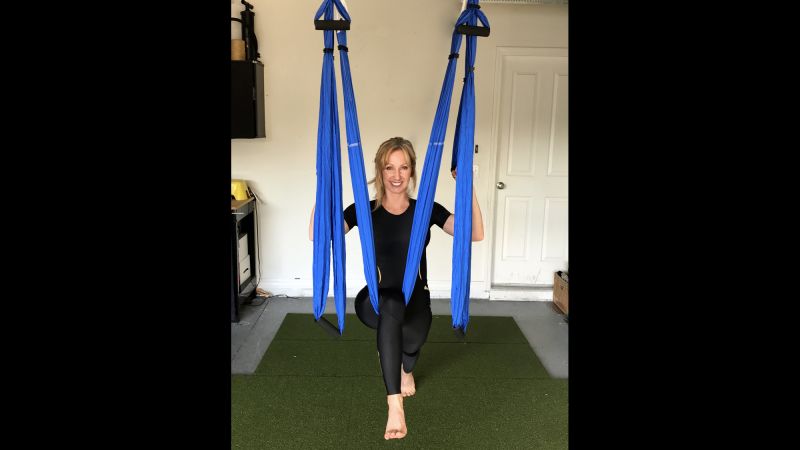
Aerial lunge
Courtesy D. Santas
Stand behind your swing. Hold the middle handles on either side for support as you step your right foot through the hammock center. Allow the swing to support your upper leg, just above the knee, while your lower leg hangs above the floor. Your left foot remains grounded, pointing straight ahead. As you gently lean forward into a lunge position, your left heel can rise, but keep your toes down. Center your weight through your core and leverage the resistance of the swing to help balance. Take five long, deep breaths. Repeat on the other side. Once you’ve mastered balance and comfort in your lunge, add a twist.
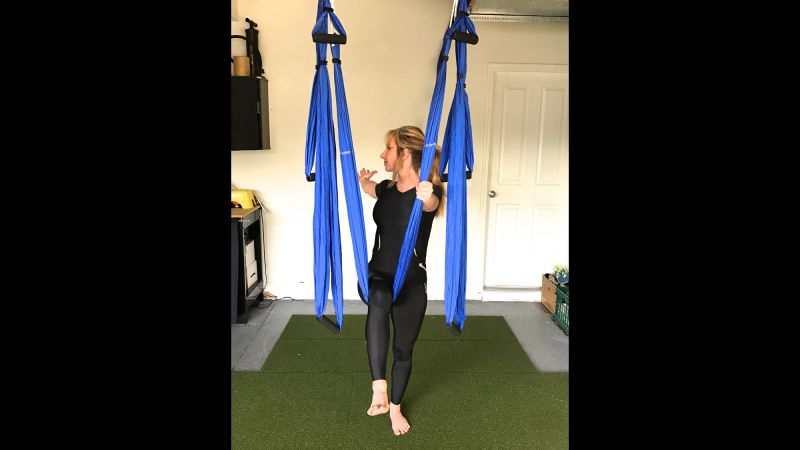
Twisting aerial lunge
Courtesy D. Santas
From the lunge position with your right leg forward, move your hands from the handles to the sides of the hammock at shoulder height. Gently press your left hand forward as you release your right hand and reach behind you, rotating from the middle of your back. Turn your head to look back toward your open right palm. Take three to five long, deep breaths. Repeat on the other side.
Start swinging
Courtesy D. Santas
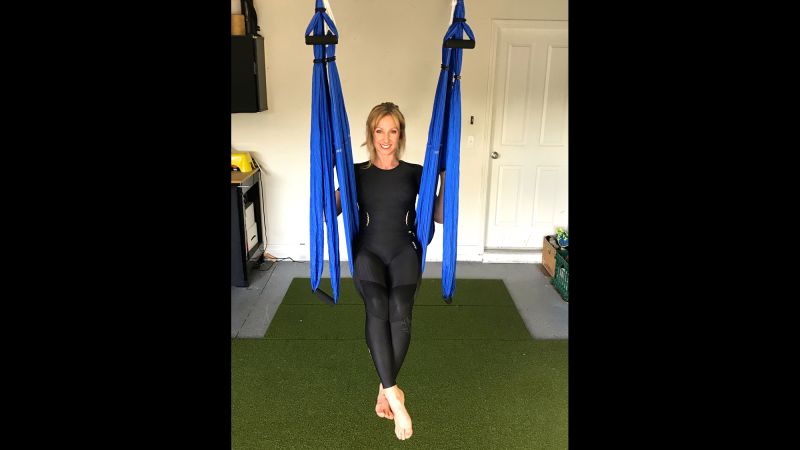
Remember that your swing is only about 3 feet off the floor, so try not to be intimidated by the notion of “flying.” When you’re ready to take both feet off the floor, approach it like you would a playground swing.
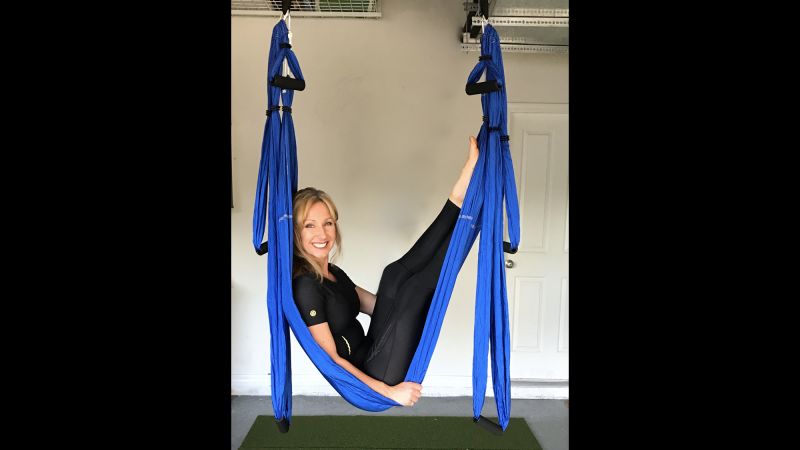
Stand in front of your swing and back up into it so that the fabric is touching your bottom. Reach up and back to grasp the highest handles on either side. Come up onto your tiptoes, pulling on the handles to help elevate yourself into the swing. Engage your abdominal muscles and hinge from your hips to push your bottom into the hammock. Slide your hands down the sides of the fabric or take hold of the middle handles. Relax into your swing the way you did when you were a child. Try extending your legs. Bend your knees. Do whatever feels comfortable. Take 10 or more long, deep breaths.
Turn upside-down
Note: Inverting is contraindicated if you have untreated high blood pressure. If you are unsure of whether being upside-down is safe for you, check with your doctor.
Once you’ve established a level of comfort with being in your swing, you should be ready to try an inversion of a simple yoga pose, which will give you all the spine-decompressing benefits I mentioned earlier.
Inverted cobbler’s pose
Courtesy D. Santas
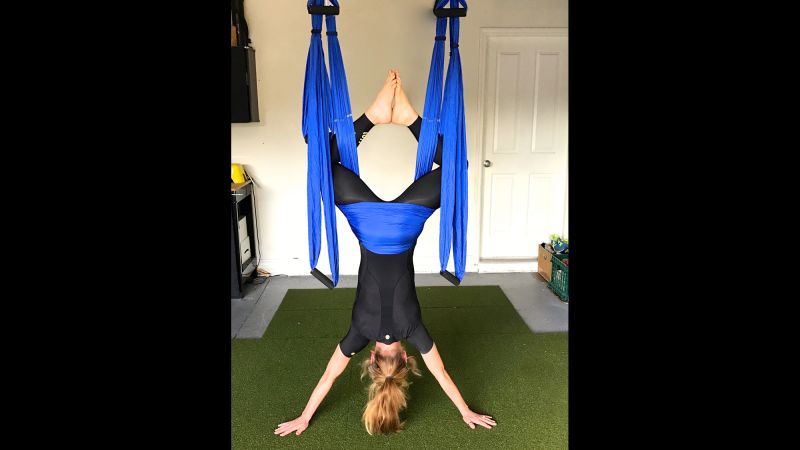
From a basic seated position in your swing, holding the sides of the fabric hammock, spread your legs out in a straddle as far as you can. Slowly lean backward, letting your hands slide down loosely, allowing the hammock to support your hips and low back as you turn upside-down. Once you’re inverted, release your hands to the floor to rest with your arms out wide. To finish the pose, bend your knees to wrap around the front of the fabric and bring the soles of your feet together (as pictured). Take five or more long, deep breaths. Return to the seated swing position by reversing the steps you took to get there, ultimately pulling yourself upright using your core and arm strength while holding the handles or fabric.
If you’re OK with being upside-down and you’re a more seasoned yogi on the mat, you might want to move into a familiar, more advanced, posture from cobbler’s pose.
Pigeon pose
Courtesy D. Santas
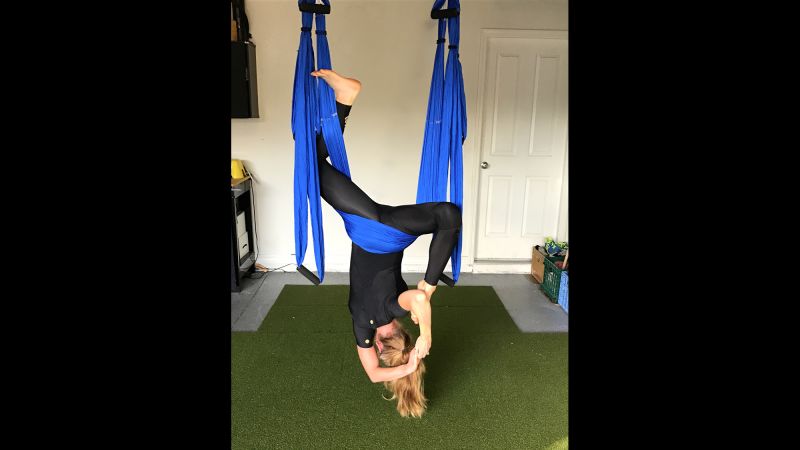
From inverted cobbler’s position, look up at your legs. Keeping your left leg wrapped around the front of the hammock, move your left foot up and over to wrap around the fabric again for extra support (as shown). If desired, you can hold the lower handles or the sides of the hammock while you move your legs. Allow your right leg to release from around the fabric and rotate it back as you would in a traditional pigeon pose on the floor. You can then rest there in an aerial version of pigeon, letting your hands return to the floor, or you can move into the King Pigeon variation I’m doing in the photo. To progress as pictured, bend your right knee so that your foot drops toward the floor. Reach back with your right arm to catch your foot or toes in the crook of your elbow. Finish by sweeping your left arm up and back to clasp your hands over your head. Hold your version of pigeon for five long, deep breaths. Reverse the steps to return to your upright seated posture and repeat on the opposite side.
Do what’s comfortable
As you play with your yoga swing, don’t be afraid to move in ways that feel comfortable to you. Relax and find ease in your swing.
Courtesy D. Santas
To learn more traditional aerial yoga poses, take a class at a studio or hire an aerial yoga instructor for a private lesson. You can also find a plethora of YouTube tutorial videos.
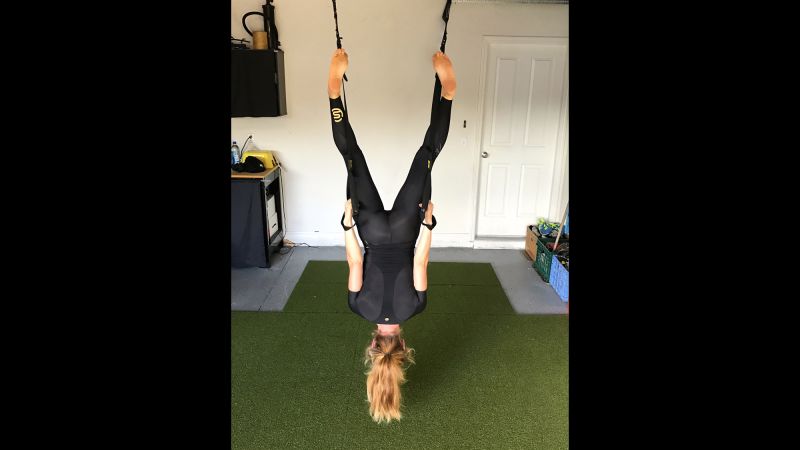
If, like many of my strength coach friends, you aren’t quite ready to make the leap to purchase a yoga swing but you’re interested in the benefits of aerial inversions, you still have options. Many gyms and performance centers have gymnastics rings, and TRX offers a dual-anchored suspension training system.
Courtesy D. Santas
Both offer alternative ways to get off the ground and turn yourself upside-down. Just remember, these require more strength and creativity to get upside-down, since they lack the support of the yoga swing’s hammock.
[……]